Commercial Trailers Manufacturer and T-R785 Case Study
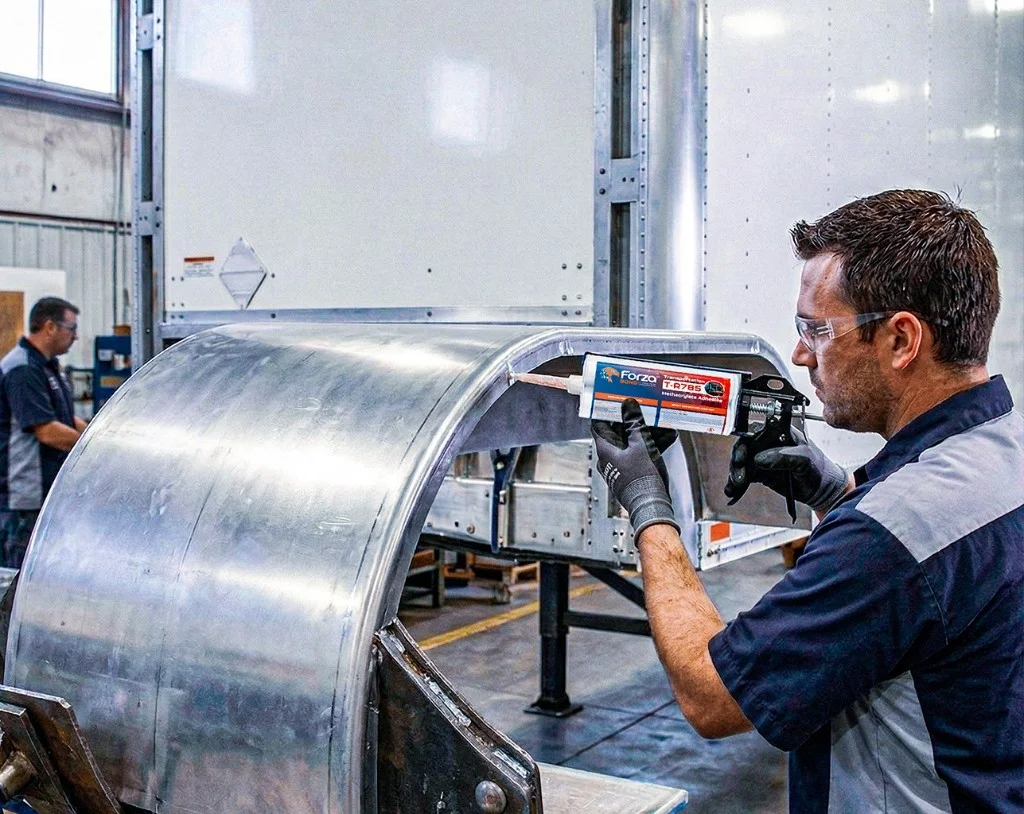
Replacing Mechanical Fasteners with Structural Adhesive Bonding in Trailer Aerodynamics
A manufacturer of specialized commercial trailers designs equipment for durability and efficiency in demanding transportation environments. As trailer design evolves, manufacturers increasingly look for ways to improve aerodynamics, reduce assembly complexity, and increase structural performance.
One component that plays a critical role in aerodynamic efficiency is the fiberglass nose cone mounted on the front of the trailer. This curved structure helps reduce wind resistance while protecting the front of the trailer body.
Historically, these nose cones were attached using mechanical fasteners. While this approach was common across the industry, the manufacturer began exploring whether a structural adhesive could provide a more efficient and durable solution.
After evaluating bonding alternatives, they partnered with Forza to transition the assembly to ForzaBOND® T-R785, a structural methacrylate adhesive designed for transportation applications.
The Challenge
Mounting large fiberglass components to metal trailer structures presents several engineering and manufacturing challenges.
The nose cone assemblies were previously secured with mechanical fasteners. Although effective, this approach created several limitations.
Time-Intensive Assembly Installing mechanical fasteners requires precise hole placement, drilling, alignment, and fastening. When repeated across multiple attachment points, this process adds significant labor time to trailer assembly.
Structural Stress at Fastener Points Each mechanical fastener concentrates load in a small localized area. Over time, vibration and road forces can stress these points, potentially loosening fasteners or enlarging holes in the surrounding material.
Design Limitations Fasteners also introduce puncture points through the structure and can restrict design flexibility when working with dissimilar materials such as fiberglass and metal.
The manufacturer wanted a solution that could simplify assembly while maintaining—or improving—the structural reliability of the nose cone mounting system.
The Solution: ForzaBOND® T-R785
To address these challenges, Forza introduced ForzaBOND® T-R785, a two-part methacrylate adhesive engineered for structural bonding in transportation applications.
Methacrylate adhesives are widely used in transportation manufacturing because they combine high structural strength with excellent impact resistance, making them suitable for assemblies exposed to vibration and environmental stress.
T-R785 bonds effectively to a wide variety of substrates, including metals and fiberglass reinforced plastics (FRP), which are commonly used in trailer construction.
The adhesive is supplied in a 1:1 mix ratio, allowing it to be dispensed through dual cartridges and static mixers for consistent mixing and application.
From a production standpoint, the adhesive provides a short working window—approximately 3–4 minutes to position components—allowing technicians to assemble parts quickly before curing begins. Handling strength is typically achieved in 5–6 minutes, with full cure reached in approximately 2–3 hours at room temperature.
These curing characteristics allowed the manufacturer to integrate adhesive bonding into their existing production workflow without slowing the assembly line.
Results Achieved
After transitioning from mechanical fasteners to adhesive bonding with ForzaBOND® T-R785, the manufacturer realized several operational and performance improvements.
Faster Assembly Eliminating drilling and fastener installation significantly reduced the time required to mount each nose cone.
Improved Load Distribution Unlike mechanical fasteners, which concentrate stress at individual points, adhesive bonding distributes loads across the entire bond line. This helps reduce localized stress and improves the overall durability of the joint.
Reduced Material and Labor Costs By eliminating numerous fasteners and simplifying installation steps, the manufacturer reduced both material costs and assembly labor.
Strong Structural Bond The adhesive forms a tough, high-strength bond capable of withstanding vibration, weather exposure, and transportation environments.
Why ForzaBOND® T-R785 Performs
ForzaBOND® T-R785 is a two-component methacrylate adhesive designed for structural bonding across a wide range of substrates.
Key technical characteristics include
Steel-to-steel strength of approximately 4,200 psi
Aluminum-to-aluminum strength of approximately 3,400 psi
Elongation of approximately 40%
High impact resistance and durability
The adhesive also resists exposure to many common transportation fluids and environmental conditions, including fuels, lubricants, antifreeze, salt water, and salt fog.
These properties allow bonded assemblies to withstand the vibration, temperature changes, and harsh operating environments typical in commercial transportation.
The Lasting Impact
By transitioning from mechanical fastening to structural adhesive bonding, the manufacturer simplified its assembly process while improving the durability of a critical aerodynamic component.
The change reduced installation time, eliminated dozens of fasteners, and created a stronger, more evenly distributed bond between fiberglass and metal components.
The project illustrates how structural adhesives can enable transportation manufacturers to rethink traditional joining methods—delivering both manufacturing efficiency and improved structural performance.
Related Articles
View All
Recent Posts
Need Expert Advice
Our engineering team is ready to help you find the perfect adhesive solution for your application.
Contact an EngineerRelated Industrial Solutions
Spray Glue Adhesives for Industrial & Commercial Applications
High-performance spray glue adhesives for industrial bonding. Learn when to use spray adhesives, their benefits, and ForzaBuilt specialized solutions.
High Temperature Adhesives for Industrial Applications
Specialized high temperature adhesives designed to maintain bond integrity in extreme heat environments. Explore ForzaBuilt heat-resistant solutions.
Non-Flammable Adhesives for Safer Industrial Bonding
Improve jobsite safety with non-flammable industrial adhesives. High-performance bonding without the fire risk of traditional solvent-based glues.
Canister Spray Adhesive Systems for Industrial Efficiency
Boost production speed with canister spray adhesive systems. Portable, pressurized, and ready-to-use for consistent industrial bonding.
Recent News & Articles
Elevate Your Performance

Join Our Newsletter
Early access to new product launches and innovations
Exclusive industry insights and technical solutions
Expert tips and best practices for your applications
Follow Our LinkedIn
Stay informed with the latest industry insights & trends
Discover our latest product launches and innovations
Get expert tips and best practices for your applications