Bonding Composite Panels Without Fasteners
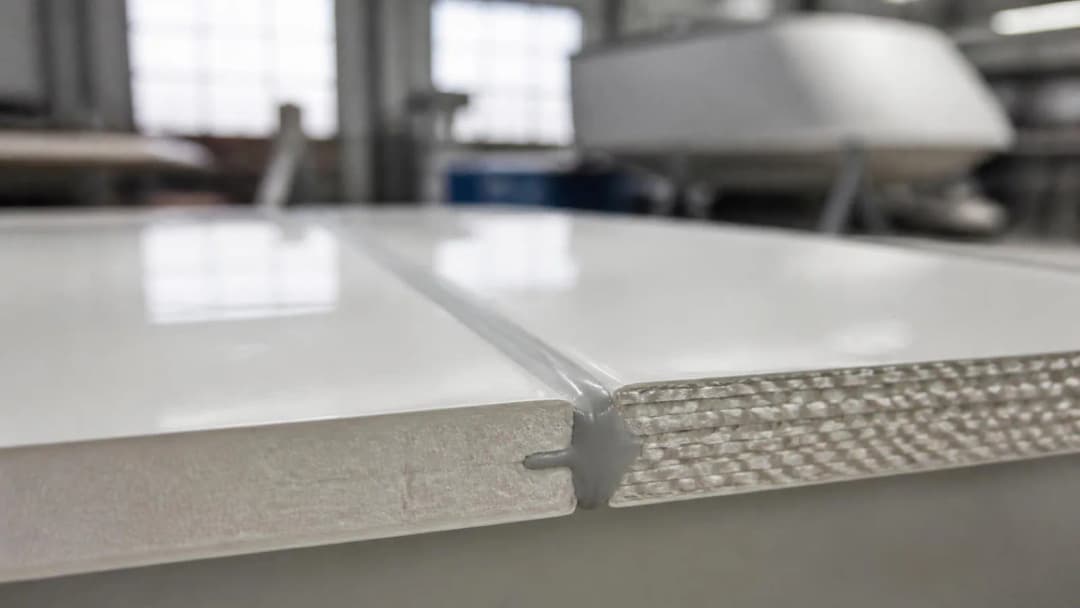
Drilling a composite panel does something drilling a steel panel does not. Composite skins carry load through continuous fiber, and a fastener hole cuts those fibers and concentrates the load that was spread across them into a single point. That point becomes a stress concentration, and a likely initiation site for damage around the hole, including delamination.
This is part of why panel builders in transportation, marine and general industry have been moving work to bonded assemblies. A structural adhesive spreads load along the whole bond line rather than through a few dozen holes, can seal the joint as it bonds rather than opening a path through it, and leaves a flush exterior with no fastener heads to finish around.
The engineering question is not whether to bond. It is which chemistry belongs on which joint, because a panel-to-frame joint on a vehicle that flexes and heats does not want the same adhesive as a rigid bulkhead. This guide covers how to make that choice.
Key Takeaways
- Fastener holes cut load-bearing fiber in composite skins and concentrate stress at the hole. A bonded joint distributes load along the bond line instead.
- Chemistry follows the joint, not the substrate alone. Rigid epoxies suit stiff structural joints; methacrylates and hybrid polymers suit joints that move.
- Thermal expansion mismatch is a failure mode that is easy to design in by accident, and it is managed through modulus selection rather than by adding adhesive.
- Surface preparation is critical to bond performance. Mold release left on an FRP panel will interfere with adhesion regardless of which adhesive is specified.
- Forza's composites line carries the
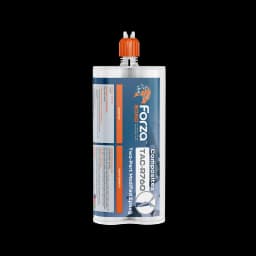
TAC-prefix. TAC-R777 is the product Forza positions for panel and structure bonding.
What Changes When a Panel Joint Is Bonded
Stress concentration is the real cost of a rivet
A composite skin is engineered as a continuous system. The fibers run where the load runs, and the resin holds them in that alignment. Punching a hole through it severs fibers across the hole's diameter and forces the load that those fibers carried to route around the interruption.
Under static load that is often survivable. Under vibration and repeated thermal cycling, those interrupted areas are where cracking and delamination can initiate. Where it happens, it often becomes visible around the fastener head while the panel itself is still well inside its design limit.
A bonded joint has no such interruption. Load transfers through the adhesive across the full overlap area. How that compares with the fastened equivalent depends on the overlap, the adhesive and the laminate, so it is a comparison worth running for your joint geometry rather than assuming.
Weight, corrosion and finish
Fasteners add up. A large vehicle body can carry a great many of them, and on a weight-sensitive build that is weight the design is spending on hardware.
Corrosion is the quieter problem. Where a steel fastener passes through an aluminum frame and a composite skin, you have dissimilar metals in contact with a moisture path running straight through the panel. That is a galvanic cell. A non-conductive structural adhesive separates the two metals and seals the joint as it bonds, which addresses the couple and the moisture path together, provided coverage along the bond line is continuous.
The finish argument is not cosmetic on products where airflow matters. A bonded panel is flush. There are no heads to fair in, no sealant rings to maintain and no fastener heads to become a corrosion and finish maintenance point later.
Matching Chemistry to the Joint
Forza's composites products carry the TAC- prefix. Four are relevant to panel work, and they are not interchangeable.
Modified epoxy, for panel and structure bonding
ForzaBOND TAC-R777 is a two-part modified epoxy described on its product page as a semi-flexible, low-exotherm epoxy for composite and marine bonding. It bonds FRP, gel coat laminates, vinylester and epoxy composites, carbon fiber and sandwich panels, and it is specified for panel-to-panel, panel-to-frame, bulkhead, stiffener and stringer bonding.
Low exotherm matters more than it sounds on thin skins and foam cores. A hot-curing adhesive in a large bond line can distort the panel it is holding or damage the core before it has cured.
Methacrylate, when surface preparation is the constraint
ForzaBOND TAC-R750 is a two-part methacrylate that bonds engineered thermoplastics, thermosets, composites and metal structural elements in any combination, and its product page states it does so without the need for surface preparation, primers or chemical wipes.
On a line where panels arrive with inconsistent surface condition, that removes a preparation step, which is worth weighing where preparation is hard to keep consistent. The claim is the product page's, so validate it on your own substrate before designing the step out.
Hybrid polymer, for joints that move
ForzaBOND TAC-OS74 is an ultra high-strength hybrid polymer structural adhesive that bonds metals, painted steel, glass, wood, most plastics, fiberglass, rubber and polystyrene foam. Hybrid polymers remain elastic after cure. That elasticity is relevant where the two substrates either side of a joint expand at different rates, though whether the product suits a given joint depends on the load it carries as well as the movement it sees.
One important exclusion
ForzaBOND TAC-R760 is a two-part epoxy for rapid bonding and repair of FRP, gel coat laminates, carbon fiber and epoxy or vinylester composites. Its product page describes it as providing non-structural composite-to-metal bonding. It is a repair and secondary bonding product. Do not specify it into a structural joint.
Managing Thermal Expansion in Mixed-Material Panels
A designed-in failure worth watching for in composite panel assembly is a rigid adhesive in a joint between two materials with different coefficients of thermal expansion.
Aluminum and a glass-reinforced composite move at meaningfully different rates. On a long panel in direct sun, that differential accumulates along the length of the joint, and the shear stress it produces is highest at the panel ends. A rigid bond line has limited capacity to accommodate that stress, and where the stress exceeds what the adhesive can take, the joint tends to fail at the ends first.
Modulus selection, rather than more adhesive, is the lever here. A lower-modulus system such as TAC-OS74 accommodates more of that movement elastically across the bond line. A rigid epoxy suits joints where both substrates move together and the joint is genuinely static, and is a poor fit where the two substrates move relative to each other.
Bond line thickness also does real work here. A thicker bond line distributes the same differential movement over more material, which lowers the strain the adhesive actually sees. There is no single recommended thickness we can give you, because it moves with the application and the substrate pair. It is worth specifying deliberately for your joint rather than letting it fall out of however the bead happens to be laid.
Spotlight: ForzaBOND TAC-R777
The reason TAC-R777 is the default recommendation for panel work is the combination of what it bonds and how it cures.
- Two-part modified epoxy, semi-flexible rather than fully rigid
- Low exotherm, which protects thin skins and foam cores on large bond lines
- Bonds FRP, gel coat laminates, vinylester and epoxy composites, carbon fiber and sandwich panels
- Specified for panel-to-panel, panel-to-frame, bulkhead, stiffener and stringer bonding
- Service temperature range of −75°F to 400°F, which is wider than most panel joints will ever ask of it
- One handling note that matters in an unheated shop: the B side stiffens below 32°F. If the material has been sitting cold it may need warming to return to a usable viscosity before it will dispense properly
Full product detail: ForzaBOND TAC-R777 Two-Part Modified Epoxy Adhesive
Application Example: FRP Panel to Metal Structure
A recurring joint in composite panel assembly is an FRP skin bonded to a metal frame or subframe. It combines every problem covered above: dissimilar substrates, a thermal expansion differential, a joint that carries real structural load, and a surface that arrives with mold release on it.
A workable sequence for this joint type runs as follows. Remove release agent and contamination from the FRP face with a residue-free solvent. Verify the metal face is free of oil and oxide. Apply a triangular bead so that closing the joint pushes air outward rather than trapping it. Fixture the panel and leave it undisturbed until handling strength is reached, because moving a panel mid-cure can disturb a bond line that will still look sound on inspection.
Surface Preparation and Dispensing
Surface preparation is critical to bond performance, and on composites the problem is specific: mold release agent. It is applied deliberately so that parts leave the tool, and it is just as effective at stopping adhesive from wetting the surface afterwards.
- Remove release agent first. A residue-free solvent wipe, changed frequently enough that you are not moving contamination around the panel.
- Watch for low surface energy skins. Adhesive that beads rather than wetting out is a sign the surface is not ready, whether from low surface energy or from residual contamination. Light abrasion increases surface area and can help, and TAC-R750's primerless claim is the alternative worth testing on your actual substrate.
- Respect mix ratio on two-part systems. Off-ratio material can cure soft or brittle, and the defect is not necessarily visible. Cartridge and static mixer systems exist to remove this variable.
- Use a triangular bead. Closing the joint spreads it from the center outward and pushes air to the edges instead of sealing voids into the middle of the bond.
- Treat shop temperature as a process variable. Cure rate moves with it, and there is a hard floor worth knowing: below 32°F the B side of TAC-R777 stiffens, and the material may need warming before it will dispense at a usable viscosity. Forza does not publish a full cure-rate curve against temperature, so validate the working window on your own line rather than against a number.
Choosing the Right System
- Structural panel and frame joints, mixed substrates: TAC-R777
- Composite to metal where surface preparation is unreliable: TAC-R750
- Joints with significant movement or thermal differential: TAC-OS74
- Repair and non-structural secondary bonding: TAC-R760
- Skin to core lamination: there is no single right answer here. The product depends on what the core is made of and how strong the bond has to be, so a recommendation given without both of those is not worth much. Send us both and we will tell you which system fits
Talk With a Composites Specialist
Panel bonding decisions are substrate-specific and joint-specific, and a modulus mismatch may not show up until the joint has been through a thermal cycle. Send us your substrate pair, your joint geometry and your line's cycle time, and we will tell you which system fits.
FAQs
What adhesive bonds FRP panels to a metal frame?
A two-part modified epoxy such as ForzaBOND TAC-R777 is the usual answer for structural panel-to-frame joints, because it bonds FRP and metal and stays semi-flexible rather than fully rigid. Where the joint sees significant movement or a large thermal differential, a hybrid polymer such as TAC-OS74 accommodates that movement elastically.
Can structural adhesive replace rivets on composite panels?
In many joints, yes. Rivets cut load-bearing fiber and concentrate stress at each hole, while a bonded joint transfers load across the full overlap. Bonding also removes the galvanic couple and the moisture path that a metal fastener through a composite skin creates. Whether it replaces rivets in a particular joint depends on the overlap available, the load path, the service temperature and how the joint will be inspected and repaired.
How do you stop composite panels delaminating during thermal cycling?
Choose the adhesive modulus to suit the expansion differential between the two substrates rather than choosing on strength alone. A rigid epoxy in a joint between materials that move at different rates can crack at the panel ends. A lower-modulus system absorbs that movement across the bond line.
Does FRP need surface preparation before bonding?
Almost always, because mold release agent remains on the surface after the part leaves the tool and will interfere with the adhesive wetting out. A residue-free solvent wipe is the minimum. ForzaBOND TAC-R750 is formulated to bond without surface preparation, primers or chemical wipes, which is worth testing on your own substrate where line conditions make preparation unreliable.
What is the difference between TAC-R777 and TAC-R760?
TAC-R777 is a semi-flexible, low-exotherm modified epoxy specified for structural panel, bulkhead and stiffener bonding. TAC-R760 is a rapid epoxy for bonding and repair, and its product page describes its composite-to-metal bonding as non-structural. Use R777 for structural joints and R760 for repair work.
Related Articles
View All articles


Recent Posts



Need Expert Advice
Our engineering team is ready to help you find the perfect adhesive solution for your application.
Contact an EngineerRecent News & Articles
Elevate Your Performance

Join Our Newsletter
Early access to new product launches and innovations
Exclusive industry insights and technical solutions
Expert tips and best practices for your applications
Follow Our LinkedIn
Stay informed with the latest industry insights & trends
Discover our latest product launches and innovations
Get expert tips and best practices for your applications