Adhesives for Bus and Coach Manufacturing
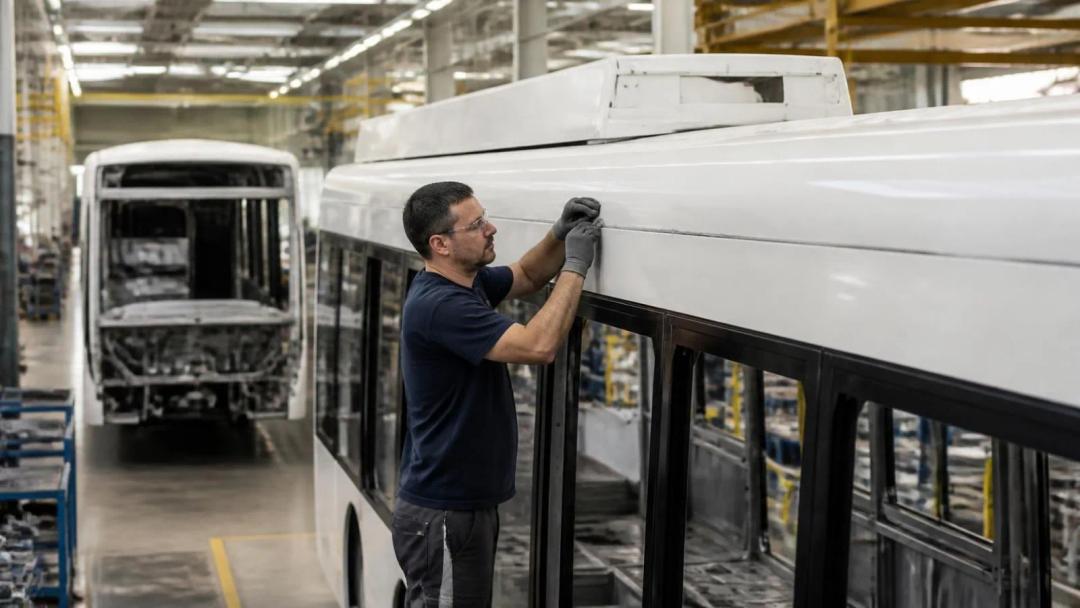
A bus is not a big car. It is a long, flexible, heavily glazed structure that twists over every driveway apron, carries passengers over a floor that has to stay quiet, and spends its life outdoors in whatever the route throws at it.
That combination is part of why coach builders have moved a large share of body joints from mechanical fastening to bonding. A fastened joint on a structure that flexes can work its holes oversize over time. A bonded joint distributes load along the whole seam, seals it in the same operation, and can damp vibration that a rigid fastened panel transmits into the saloon.
The question is rarely whether to bond. It is which product belongs at which point in the build, because a roof seam, a structural stiffener, a headliner and a glazing bond are four different engineering problems that happen to sit on the same vehicle.
Key Takeaways
- Bus and coach bodies flex continuously. Selection has to weigh fatigue behavior and the joint's ability to accommodate movement, not peak shear strength alone.
- Forza serves four distinct operations on a bus build: sealing, structural bonding, interior lamination, and glazing and edge work.
- ForzaBOND T-R785, a two-part methacrylate, carries the structural panel and stiffener work.
- ForzaSEAL T-OS150 is positioned by Forza for roof seam, sidewall and panel sealing on buses, and cures with moisture rather than heat.
- ForzaTAPE T-T415 is specified for panel attachment on buses, including bonding roof panels to roof bows.
Why Coach Builders Moved Away From Fasteners
A long body is a moving body
The longer the structure, the more it works. A coach body twists along its length under normal road loading, and every fastened joint converts that movement into a point load at each fastener.
Over a long service life, those holes can elongate. Once a hole has gone oversize the fastener stops carrying its share, load redistributes to its neighbors, and the process can accelerate. The symptom an operator reports is often a rattle, and the joint may have been working loose for some time before that.
A bonded seam has no holes to elongate. It transfers load continuously along the bond line, and because a structural bond line retains some elasticity, it can accommodate more of that movement.
Weight, and what it is worth on a bus
Every pound of hardware on a bus body is a pound not available for passengers, batteries or range. A large body carries a great many fasteners, and the weight of the hardware is only part of it. Fastened construction also needs the local reinforcement that spreads the load away from each hole.
Noise, which passengers actually notice
This matters more on a bus than on a truck. A rigid fastened joint transmits high frequency vibration directly through the structure into the passenger compartment. An elastic bond line damps it. On a vehicle whose product is the ride, that is a specification rather than a nicety.
Corrosion at dissimilar joints
Where a steel fastener passes through an aluminum skin you have created a galvanic cell with a moisture path running through the middle of it. Corrosion can progress inside the joint, where it is not visible until it shows at the skin. A non-conductive structural adhesive separates the two metals and seals the joint as it bonds, addressing the couple and the water path together where the bond line is continuous.
The Four Operations on a Bus Build
Forza's products map to four distinct jobs on a coach body. Getting the right product to the right job matters more than any single specification.
Sealing
Roof seams, sidewall joints and panel joints. This is where ForzaSEAL T-OS150 sits. It is a semi self-leveling hybrid polymer sealant that cures with atmospheric moisture rather than heat, which matters more than it sounds: a heat-cured sealer ties the line to an oven, and the oven becomes the constraint on throughput. Its semi self-leveling behavior is what suits it to riveted joints, fastener lines and irregular seams, where the material has to flow into a profile rather than be tooled into one.
Current figures are 177 psi tensile strength, 280 percent elongation at break, and a skin time of 120 minutes.
That elongation figure is worth reading carefully. Elongation at break is a tensile test result, not a movement capability rating of the kind expressed as an ASTM C920 class, and Forza does not publish a movement class for this product. Read it as an indication that the cured sealant is highly extensible rather than as a rating for the cyclic movement a roof seam will see over its life. If your specification calls for a movement class, ask us rather than reading one across from the elongation figure.
Structural bonding
Stiffener bonding, structural mounting, bonding metal and FRP panels together, and replacing rivets, fasteners and welding where dissimilar materials meet. ForzaBOND T-R785 is the workhorse here, with ForzaBOND T-R679 as the modified epoxy option where the joint is stiffer and the substrates move together.
Interior lamination
Seating, wall panels, headliners, flooring and insulation lamination. Large-area work where coverage and open time matter more than ultimate strength, and where shop safety is part of the specification. ForzaBOND IC956 is a non-flammable, non-methylene-chloride contact adhesive built for exactly this kind of large-surface lamination.
Glazing and edge work
Glazing bonding, panel edge protection, and holding panels in position while a structural adhesive cures. That last one is easy to overlook and expensive to get wrong, because a panel that moves during cure produces a bond line that looks perfect and is not.
Spotlight: ForzaTAPE T-T415
The tape deserves its own section because it does a job nothing else on the list does well.
ForzaTAPE T-T415 is a double-coated ultra high bond acrylic foam tape specified for panel attachment in trailers, truck bodies, ambulances, RVs, buses and emergency vehicles, including bonding roof panels to roof bows.
Published performance:
- 90 degree peel of 30 psi initial on stainless steel at 20 minute dwell, rising to 56 psi final on stainless steel at 72 hour dwell
- Static shear of 52 oz at 68°F, and 8.8 oz at 194°F
- Dynamic shear of 70 psi
- Long term service to 302°F, with short term capability to 392°F
- 0.045 inch thickness
The static shear figures are worth reading together. 52 oz at 68°F falling to 8.8 oz at 194°F shows how much of the tape's shear holding power goes as temperature rises, and a dark bus roof in direct summer sun runs well above ambient. The elevated-temperature figure is therefore the relevant one for a roof application. Forza publishes no shear-versus-temperature curve between those two points, so treat them as two measured points rather than as the ends of a known slope.
Its practical use on a coach line is immediate fixturing. The tape can hold a panel in position as it is placed, which can allow a structural adhesive beside it to cure without clamping. Whether it holds a given panel depends on the panel weight, the contact area achieved and the surface condition, so this is worth proving on the actual panel rather than assuming from the published figures.
What the Structural Bond Actually Delivers
ForzaBOND T-R785, the two-part methacrylate carrying the structural work:
- Roughly 3 to 4 minutes of working time to position components
- Handling strength typically in 5 to 6 minutes
- Full cure in approximately 2 to 3 hours at room temperature
- Approximately 4,200 psi steel to steel, and 3,400 psi aluminum to aluminum
- Elongation of approximately 40 percent
- Surfaces need only be clean and dry. In most cases no abrasion or solvent wipe is necessary
That last point is the one that changes a production line. Structural adhesives on mixed substrates commonly arrive with a surface preparation regime attached, and preparation is a step that is hard to keep consistent under schedule pressure. Note that the data sheet gives this as general guidance rather than a bus-specific instruction, so validate it on your own substrates before designing the step out.
The 40 percent elongation is one reason this chemistry is specified on flexing structures rather than static assemblies. A rigid epoxy will typically test higher in a static lap shear. How each behaves over a service life of continuous flexing depends on the joint design as much as the chemistry, so that comparison belongs to the specific joint rather than to a general ranking.
Choosing Between Them
- Roof seams, sidewall joints, panel joint sealing: ForzaSEAL T-OS150
- Structural panel and stiffener bonding, metal or FRP: ForzaBOND T-R785
- Stiffer structural joints where substrates move together: ForzaBOND T-R679
- Panel attachment, roof panel to roof bow, immediate fixturing: ForzaTAPE T-T415
- Interior lamination, seating, headliners, flooring: ForzaBOND IC956
Talk With a Transportation Specialist
Bus and coach bonding decisions come down to three things: the substrate pair, the joint geometry, and the line speed you need to hold. Send us those and we will tell you which system fits, or tell you if bonding is the wrong answer for that joint.
FAQs
What adhesive is used in bus manufacturing?
Four different ones, because a bus build has four distinct bonding jobs. Roof seam and sidewall sealing uses a moisture-cure hybrid polymer sealant such as ForzaSEAL T-OS150. Structural panel and stiffener bonding uses a two-part methacrylate such as ForzaBOND T-R785. Panel attachment and fixturing uses an ultra high bond acrylic foam tape such as ForzaTAPE T-T415. Interior lamination uses a non-flammable contact adhesive such as ForzaBOND IC956.
Can adhesive replace rivets on a bus body?
In many joints, yes. A rivet carries load at a point and can work its hole oversize over a service life of continuous movement. A bonded joint transfers load along the whole seam, seals it against water in the same operation, and removes the galvanic couple created where a steel fastener passes through an aluminum skin. Whether it replaces rivets in a particular joint depends on the overlap available, the load path, and how the joint is inspected and repaired in service.
What holds a bus roof panel to the roof bow?
An ultra high bond acrylic foam tape is one common answer, and ForzaTAPE T-T415 is specified for exactly that application on its product page. It can also hold panels in position while a structural adhesive beside it cures, which can remove clamping from the operation.
Does bonding a bus panel need surface preparation?
The T-R785 data sheet asks only that surfaces be clean and dry, and states that in most cases no abrasion or solvent wipe is necessary. That is general guidance rather than a bus-specific instruction, so validate it against your own substrates and coatings before designing the preparation step out of the line.
Why does a bus sealant need to be extensible?
Because a long body moves. A roof seam on a coach has to accommodate the structure twisting under road loading and the skin expanding against a frame that expands at a different rate. T-OS150 publishes 280 percent elongation at break, which indicates a highly extensible cured sealant. That is a tensile test result rather than a movement capability class, which describes cyclic joint movement over time; Forza does not publish a movement class for this product. A stiffer, higher-tensile sealant is generally more likely to lose adhesion at the ends of a long seam, but what a given seam needs is set by the joint width and the movement the structure actually imposes, not by the elongation figure alone.


Related Articles
View All articles
Recent Posts
Need Expert Advice
Our engineering team is ready to help you find the perfect adhesive solution for your application.
Contact an EngineerRecent News & Articles
Elevate Your Performance

Join Our Newsletter
Early access to new product launches and innovations
Exclusive industry insights and technical solutions
Expert tips and best practices for your applications
Follow Our LinkedIn
Stay informed with the latest industry insights & trends
Discover our latest product launches and innovations
Get expert tips and best practices for your applications