Panel Bonding Adhesive for Truck Bodies
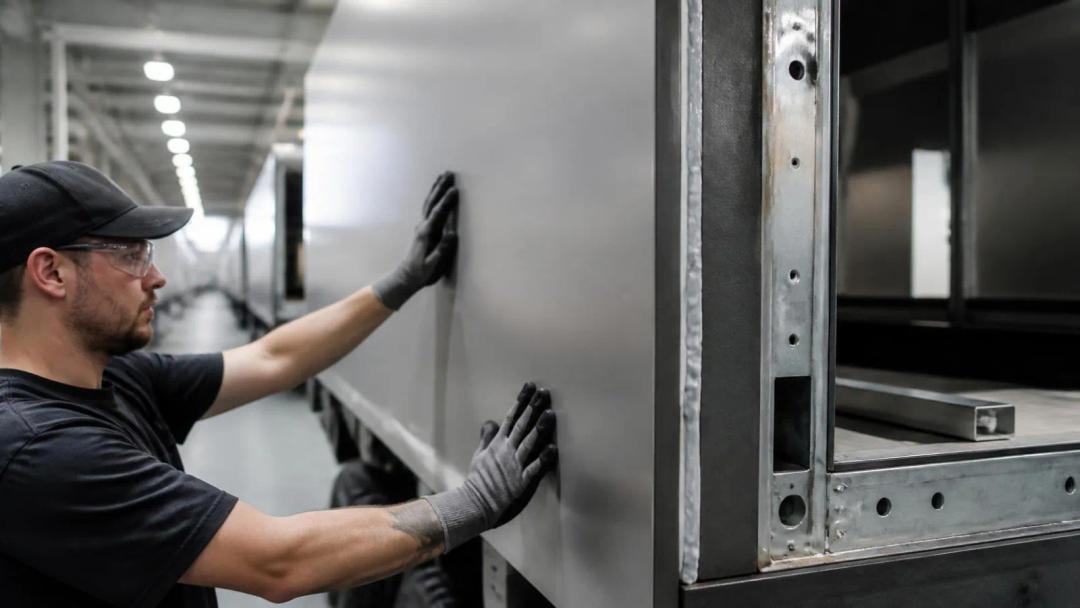
A rivet through a truck body panel does three things at once, and two of them are problems. It holds the panel, it concentrates the load that was spread across the joint into a single point, and it opens a path for water into the space between the panels.
Over a long service life those can show up as elongated holes, corrosion between skins where water has tracked in, and the rattle that tells a driver the body has started working against itself. On insulated and refrigerated units, each fastener that passes through the insulation line is also a thermal bridge.
Structural bonding replaces the point loads with a continuous bond line, seals the joint as it bonds, and removes the fastener hardware from the finished vehicle. This guide covers what a truck body bond actually has to survive, which Forza chemistry suits which joint, and two applications where builders made the switch.
Key Takeaways
- Rivets concentrate stress at each hole and open a moisture path between panels. A bonded joint distributes load along the full bond line and can seal it in the same operation.
- Bonding removes the galvanic couple you create whenever a steel fastener passes through an aluminum skin.
- Truck body joints move. Static shear strength alone is not a sufficient basis for selection; fatigue behavior and the joint's ability to accommodate movement matter as well.
- ForzaBOND T-R785, a two-part methacrylate, is the structural panel bonding product for metal and FRP on trailers and truck bodies.
- ForzaSEAL T-OS150 replaced a heat-cured seam sealer on a heavy truck line, per Forza's published case study, removing a 40 foot curing oven from the process.
Why Builders Are Replacing Rivets
Point loads and the holes they leave
A fastened joint carries its load through the fasteners. Every one of them is a stress concentration, and the panel around it is doing more work than the panel six inches away.
Highway service is a fatigue problem rather than a static one. The torque and vibration of road operation can work holes oversize over time. Once a hole has elongated, the fastener no longer carries what it was designed to carry, load redistributes to its neighbors, and the process can accelerate. A bonded joint has no holes to elongate.
Corrosion and thermal bridging
Where a steel fastener passes through an aluminum skin you have two dissimilar metals in electrical contact with a moisture path running between them. That is a galvanic cell, and corrosion can progress inside the joint, where it is not visible until it shows at the skin.
A structural adhesive of this type is electrically non-conductive. It separates the two metals and seals the joint in the same operation, which addresses the couple and the water path together where coverage along the bond line is continuous.
On insulated and refrigerated bodies there is a second cost. Each fastener that penetrates the insulation line conducts heat through it, and across a whole body those add up in the thermal load the cooling system carries.
Weight, finish and noise
A large body carries a great many fasteners, and replacing them with a bond line is weight recovered.
The exterior is cleaner too, which matters on any vehicle carrying a wrap or livery, because there are no heads to work around and no rings to maintain. And because a structural bond line retains some elasticity, it can damp high frequency vibration that a rigid fastened joint transmits through the structure.
What a Truck Body Bond Has to Survive
Vibration and fatigue
Static shear strength is the number most often quoted, and on its own it does not describe how a joint behaves under repeated loading. A high modulus adhesive with strong shear numbers can still fail on a truck body, because what the joint sees is many small cycles rather than one large load.
Elongation is one of the properties that matters here, because the bond line has to move with the structure and return, repeatedly, for the life of the vehicle. It is not the only one. Fatigue behavior, modulus, bond line thickness and the joint geometry all bear on whether a joint survives that duty, and elongation at break is a tensile test result rather than a rating for cyclic movement. This is part of why methacrylates and hybrid polymers are commonly specified on truck bodies rather than rigid epoxies, despite epoxies testing higher in a static lap shear.
Thermal expansion between dissimilar substrates
Aluminum and steel expand at meaningfully different rates. On a trailer standing in the sun, the skin grows against a frame that does not, and the differential accumulates along the length of the panel. Shear stress is highest at the ends of the joint.
A rigid bond line has limited capacity to accommodate that movement. A more elastic one can take more of it across the bond line.
Mixed substrates
Modern builds bond FRP and SMC panels to galvanized steel and powder-coated aluminum. These are not easy surfaces. Galvanized steel carries a zinc layer with its own surface chemistry, and composite panels arrive with mold release on them.
T-R785 is specified for exactly this combination. Its product page lists bonding metal and FRP side panels in trailers and specialty vehicles, structural bonding of stiffeners in truck bodies and semi trailers, and replacing rivets, fasteners and welding of dissimilar materials in semi, livestock and cargo trailers.
Spotlight: ForzaBOND T-R785
A two-part methacrylate built for structural panel work on transportation bodies.
- Bonds metal to metal, metal to FRP, and dissimilar material combinations
- Specified for side panel bonding, stiffener bonding, and rivet, fastener and weld replacement
- Roughly 3 to 4 minutes of working time to position components, handling strength typically in 5 to 6 minutes, full cure in approximately 2 to 3 hours at room temperature
- Approximately 4,200 psi steel to steel, approximately 3,400 psi aluminum to aluminum, elongation approximately 40 percent
- Surfaces need only be clean and dry. In most cases no abrasion or solvent wipe is necessary
Product detail: ForzaBOND T-R785 Two-Part Methacrylate Adhesive
Real-World Application: FRP Nose Cone to Metal Structure
The challenge
A commercial trailer manufacturer was mounting fiberglass nose cones to metal trailer structures with mechanical fasteners.
The fastening itself was time-intensive on a part that size. Each fastener concentrated stress into the FRP at the attachment point, which is the least forgiving thing you can do to a composite panel. And because the joint was fastened rather than bonded, it constrained what the design team could do when joining dissimilar materials.
The solution
The builder moved the joint to ForzaBOND T-R785. The working window of roughly 3 to 4 minutes gave the crew time to position a large panel accurately, and handling strength at 5 to 6 minutes meant the assembly could move to the next station without long fixturing.
Results achieved
- Drilling and fastener installation eliminated from the operation
- Load distributed across the bond line rather than concentrated at fastener points
- Material and labor cost reduced
Full case study: Commercial Trailers Manufacturer and T-R785
Sealing the Seams: ForzaSEAL T-OS150
Panel bonding usually arrives with a sealing requirement attached, and the sealer is often the thing setting line speed.
A heavy-duty commercial truck manufacturer was running a heat-activated plastisol seam sealer. Parts had to travel through a 40 foot curing oven before the sealant would fully set, which consumed floor space, drew energy continuously, and stopped parts advancing until cure had completed.
ForzaSEAL T-OS150 is a semi self-leveling hybrid polymer sealant that cures with moisture rather than heat. Per the published case study, moving to it removed the oven from that process.
Current TDS figures: tensile strength of 177 psi, elongation at break of 280 percent, skin time of 120 minutes. It bonds across steel, aluminum, glass, concrete and plastics.
Full case study: Leading Truck Manufacturer and T-OS150
Surface Preparation and Application
Bond failures frequently occur at the interface rather than within the adhesive itself, which is why surface condition deserves as much attention as product selection.
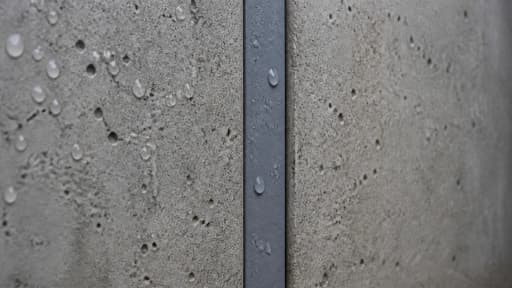
- Degrease, then verify. The water break test is the cheapest check available. After degreasing, mist the surface with deionized water. Water that beads indicates contamination is still present. Water that sheets out flat is a good sign the surface is ready.
- Watch what you wipe with. Shop rags carrying silicone or laundry detergent residue can contaminate a surface rather than clean it. Lint-free, solvent-compatible wipes only.
- Clean and dry is what the data sheet asks for. The T-R785 data sheet states that surfaces should be clean and dry, and that in most cases no abrasion or solvent wipe is necessary. That is general guidance rather than a galvanized-specific instruction, so validate it against your own substrate and zinc coating before designing the preparation step out.
- Bead consistency is structural. Over the length of a trailer panel, an inconsistent bead gives inconsistent stress distribution along the joint, which works against the reason for bonding it. Metered dispensing is what makes this repeatable at length.
- Check the squeeze-out. Consistent squeeze-out along the bond line is a practical indication that the gap filled.
A note on shop conditions: cure rate moves with temperature and humidity, and on a moisture-cure product like T-OS150 humidity is an input rather than a nuisance. Forza does not publish a cure-rate curve against temperature or humidity for this product, so plan around the stated skin time and validate on your own line rather than against a number.
Choosing the Right System
- Structural panel and stiffener bonding, metal or FRP: ForzaBOND T-R785
- Seam sealing, especially replacing a heat-cured sealer: ForzaSEAL T-OS150
- Rigid structural joints where both substrates move together: ForzaBOND T-R679, two-part modified epoxy
- Immediate fixturing, panel attachment and secondary sealing: ForzaTAPE T-T415, a double-coated ultra high-bond acrylic foam tape, 0.045 inch thick. Published data, with the test context as the product page gives it: 90 degree peel of 30 psi initial on stainless steel at 20 minute dwell, rising to 56 psi final on stainless steel at 72 hour dwell; static shear of 52 oz at 68°F and 8.8 oz at 194°F; dynamic shear of 70 psi; long-term service to 302°F with short-term capability to 392°F.
- Large-area skin lamination: ForzaBOND IC956, a non-flammable, non-methylene-chloride contact adhesive. Our separate post on the EPA methylene chloride phase-out covers that transition in more detail.
Talk With a Transportation Specialist
Panel bonding decisions come down to the substrate pair, the joint geometry and the line speed you need to hit. Send us those three and we will tell you which system fits, or tell you if bonding is the wrong answer for that joint.
FAQs
When can panel bonding adhesive replace welding on a truck body?
The two carry load in different ways, so this is a joint design question rather than a ranking. A weld concentrates the joint at discrete points or along a narrow line. A bonded joint transfers load across the whole overlap, at a much lower stress per unit area, which means it needs enough overlap to carry the load at the adhesive's design stress. Bonding becomes a practical alternative where that overlap is available, where the substrates cannot be welded to each other at all, such as FRP to steel, where heat input would distort a thin panel or damage a coating or an adjacent material, and where the joint can be held undisturbed until handling strength is reached. It is the weaker option where the joint is narrow or has to carry concentrated load through a small area, where service temperature approaches the adhesive's limit, or where the joint has to be cut and remade in service. A joint designed for welding will not usually perform well if an adhesive is simply substituted into it, and the reverse is equally true. Design the joint for the method.
Can you bond panels to galvanized steel?
Yes. The T-R785 data sheet asks only that surfaces be clean and dry, and states that in most cases no abrasion or solvent wipe is necessary. That is Forza's general guidance rather than a galvanized-specific instruction, so validate it against your own substrate and zinc coating before relying on it for a production joint.
How long before a bonded panel can be moved?
That depends on the product. On the commercial trailer application using T-R785, handling strength was typically reached in 5 to 6 minutes, with full cure in approximately 2 to 3 hours at room temperature. Handling strength and full cure are different milestones, and line design should be built around the first.
What is the difference between a methacrylate and an epoxy for truck panels?
Epoxies are more rigid and test higher in static shear, which suits joints where both substrates move together. Methacrylates such as T-R785 carry more elongation, which is one of the properties that matters when a panel joint is flexing over the road and when two dissimilar substrates expand at different rates. Elongation on its own does not determine suitability; the joint geometry, the load path and the service temperature matter as much.
Does bonding help with corrosion?
Yes, and this is one of the clearer advantages. A steel fastener through an aluminum panel creates a galvanic couple with a moisture path straight through the joint. A non-conductive structural adhesive separates the two metals and seals the joint as it bonds, addressing both, provided the bond line is continuous.


Related Articles
View All articles
Recent Posts
Need Expert Advice
Our engineering team is ready to help you find the perfect adhesive solution for your application.
Contact an EngineerRecent News & Articles
Elevate Your Performance

Join Our Newsletter
Early access to new product launches and innovations
Exclusive industry insights and technical solutions
Expert tips and best practices for your applications
Follow Our LinkedIn
Stay informed with the latest industry insights & trends
Discover our latest product launches and innovations
Get expert tips and best practices for your applications