How Adhesives Impact Your Manufacturing – Productivity and Efficiency

<h1><strong>How Adhesives Impact Your Manufacturing – Productivity and Efficiency</strong></h1>
The Evolution of Fastening in Trailer Manufacturing
Traditional fastening methods, such as bolts, nuts, rivets, and welding, have long been used to provide structural strength and rigidity in manufacturing semi-trailers, enclosed trailers, cattle trailers, RVs, and cargo haulers. While effective in the past, these methods have significant performance, efficiency, and long-term durability limitations.
Enter advanced industrial adhesives and high-bond tapes—cutting-edge solutions that are revolutionizing trailer construction. By switching to ForzaBOND® T-R785 and ForzaTAPE® T-T415, manufacturers can streamline production, enhance structural integrity, and reduce overall costs.
The Problem with Traditional Fastening Methods
- Time-Consuming Assembly
- Welding, bolting, and riveting require extensive labor and precise alignment.
- Slower production cycles lead to increased costs and manufacturing delays.
- Structural Weakness & Failure Points
- Drilled holes weaken materials, creating stress points that lead to fatigue.
- Welds and rivets are prone to cracks, corrosion, and long-term wear.
- Added Weight & Bulk
- Mechanical fasteners add unnecessary weight, reducing fuel efficiency.
- Trailers need lightweight yet strong solutions to improve payload capacity.
- Difficulty in Achieving a Seamless, Aesthetic Finish
- Bolts and rivets create unsightly protrusions on trailer exteriors.
- Welding and fastening can distort metal panels, affecting quality.
To address these issues, manufacturers need a modern bonding solution that ensures strength, longevity, and assembly efficiency.
The Advantages of Industrial Adhesives and Tapes in Trailer Manufacturing
- Faster, More Efficient Production
✅ Adhesives eliminate the need for pre-drilling, reducing assembly time. ✅ No curing or drying delays—quick bonding accelerates workflow. ✅ Eliminates rework caused by misalignment in mechanical fastening.
- Superior Structural Integrity
✅ Bonds distribute stress evenly across materials, eliminating weak points. ✅ No holes or welds = stronger, fatigue-resistant trailer components. ✅ Maintains high impact resistance and flexibility in extreme conditions.
- Lightweight & Durable Construction
✅ Reduces trailer weight, improving fuel efficiency and payload capacity. ✅ Adhesives resist moisture, corrosion, and temperature fluctuations. ✅ Withstands environmental exposure—ideal for long-haul and off-road use.
- Enhanced Aesthetic & Seamless Finish
✅ No visible fasteners for sleek, professional trailer exteriors. ✅ Prevents metal panel distortion, ensuring cleaner, smoother designs. ✅ Creates an airtight, weather-resistant seal against moisture infiltration.
ForzaBOND® T-R785: High-Strength Two-Part Structural Adhesive
ForzaBOND® T-R785 is a two-part methacrylate adhesive designed for structural bonding in trailer manufacturing. It provides:
✔ Exceptional bonding strength for metals, composites, and plastics. ✔ Minimal surface preparation—no chemical wipes or primers required. ✔ Rapid curing—handling strength in just 7-10 minutes. ✔ Superior resistance to industrial cleaners, fuels, and harsh weather. ✔ Impact and vibration resistance for long-lasting trailer durability.
Best for: Structural assembly of trailer sidewalls, roofs, floors, and doors where high bond strength and flexibility are essential.
ForzaTAPE® T-T415: Double-Coated Ultra High Bond Acrylic Foam Tape
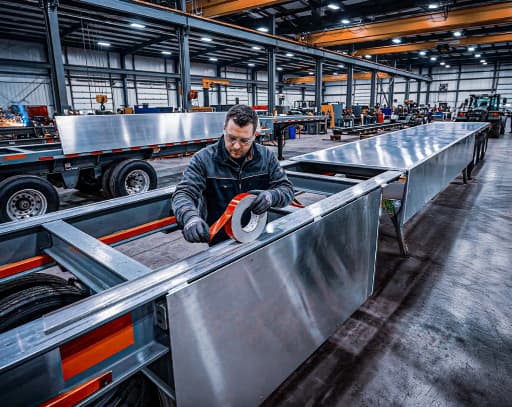
ForzaTAPE® T-T415 is a high-performance acrylic foam tape engineered to replace screws, rivets, and welding in trailer side skin applications. Key benefits include:
✔ Strong, flexible bonding to metals, plastics, and woods. ✔ Shock and stress absorption, preventing material fatigue. ✔ 100% closed-cell structure for moisture and solvent resistance. ✔ Easy application with die-cut customization options. ✔ Long-lasting durability for interior and exterior trailer components.
Best for: Bonding side panels, decorative trims, interior partitions, and other trailer components requiring aesthetic, high-strength adhesion.
How to Transition to Industrial Adhesives Successfully
If you still rely on bolts, rivets, or welds, now is the time to upgrade. Here’s how to make a seamless transition:
1️. Evaluate your current fastening processes—identify areas where adhesives can replace outdated methods. 2️. Test & validate adhesive solutions—ensure optimal bond strength and material compatibility. 3️. Train your team on proper adhesive application—maximize efficiency and reliability. 4️. Work with Forza experts to select the right high-performance adhesives for your specific needs.
FAQs: Industrial Adhesives in Trailer Manufacturing
Can adhesives fully replace welding, rivets, and bolts?
Yes! Modern adhesives provide equal or better strength without traditional fasteners’ added stress points, weight, or installation complexity.
How do adhesives improve durability in trailers?
Adhesives distribute load stress more evenly, reducing fatigue failure. They also resist vibration, moisture, and temperature extremes, leading to longer-lasting trailers.
What’s the difference between adhesive tapes and structural adhesives?
- ForzaBOND® T-R785 is a structural adhesive ideal for high-strength load-bearing applications.
- ForzaTAPE® T-T415 is a high-bond acrylic tape designed for fast, clean, and aesthetic panel bonding.
Are adhesives difficult to apply?
Not at all! Forza adhesives are designed for easy, efficient application. Most require minimal surface prep, and some can be applied without clamps or fixtures.
Conclusion: The Future of Trailer Manufacturing is Adhesive-Based
Industrial adhesives are transforming the trailer industry, offering stronger, lighter, and more efficient bonding solutions than traditional fasteners. With ForzaBOND® T-R785 and ForzaTAPE® T-T415, manufacturers can enhance productivity, durability, and overall trailer performance.
Ready to upgrade your manufacturing process? Contact Forza today for expert guidance on switching to advanced industrial adhesives! ?
Related Articles
View All

Recent Posts



Need Expert Advice
Our engineering team is ready to help you find the perfect adhesive solution for your application.
Contact an EngineerRecent News & Articles
Elevate Your Performance

Join Our Newsletter
Early access to new product launches and innovations
Exclusive industry insights and technical solutions
Expert tips and best practices for your applications
Follow Our LinkedIn
Stay informed with the latest industry insights & trends
Discover our latest product launches and innovations
Get expert tips and best practices for your applications